

Modern strawberry farming increasingly combines traditional growing expertise with advanced technology. While robots are not yet able to match the speed required for commercial strawberry picking, autonomous systems are already helping growers manage irrigation, disease control and crop protection more efficiently.
At Tiptree and across the wider horticultural industry, these technologies are being explored as part of a long-term investment in producing healthy crops while making farm operations more precise and sustainable.
A Greenhouse Designed for the Future
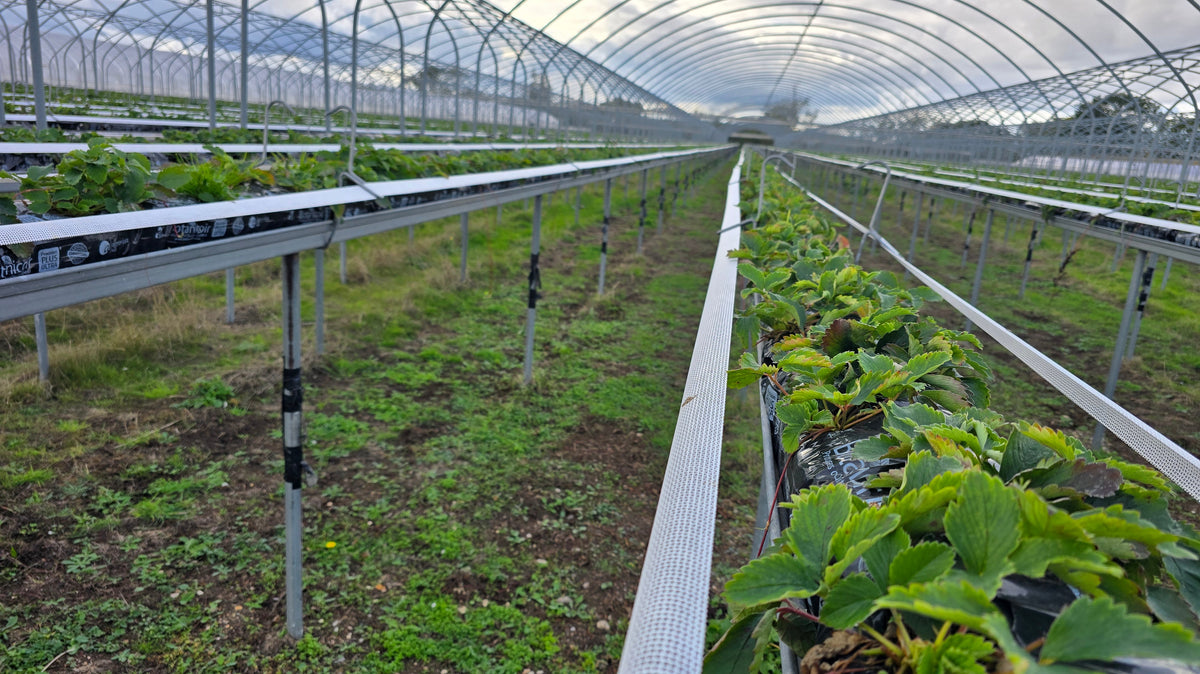
Our newest strawberry greenhouse was designed with both staff and emerging technologies in mind. The growing beds are suspended from the roof at a comfortable working height, helping to improve ergonomics for pickers while creating clear space around the crop.
The layout also provides the room needed for autonomous robots to move easily around the growing beds when carrying out tasks such as UV-C treatments and crop spraying. By incorporating these requirements into the greenhouse design from the outset, the technology can operate effectively without compromising the working environment for the people caring for the crop.
As robotic technology continues to develop, this flexible design provides opportunities to trial new equipment and techniques, ensuring the greenhouse is well placed to support future advances in strawberry production.
Precision Irrigation Removes the Guesswork
Water management is one of the most important aspects of strawberry production, particularly in Essex, which is the driest region in England. Making every drop count is essential for both crop health and sustainability.
Historically, irrigation decisions relied heavily on a grower's experience and observation. Today, irrigation is guided by technology that constantly monitors conditions around the plant roots. Soil sensors provide real-time information about moisture levels, while weather forecasts are incorporated into the system to anticipate changing conditions.
By combining these data sources, irrigation can be adjusted accurately throughout the growing season. What was once based largely on instinct can now be optimised according to the needs of the crop, helping us maintain ideal growing conditions while using water responsibly.
Why Aren't Picking Robots Used Commercially Yet?
Although robotic harvesting technologies continue to develop rapidly, commercial strawberry farms still require harvesting speeds that current picking robots cannot consistently achieve.
As a result, robotic technology on many farms is focused on tasks where automation can already deliver reliable results, including crop protection, disease management and spraying operations.
The technology is advancing quickly, but for now, robots are most effective when supporting growers rather than replacing manual harvesting teams.
Using UV-C Light Robots to Combat Disease
One of the biggest challenges in strawberry production is managing powdery mildew, a fungal disease that can spread rapidly through crops and affect both plant health and fruit quality.
For many years, fungicides formed the backbone of disease management programmes.
Today, UV-C robots provide another way of tackling the problem, helping us to reduce reliance on chemical controls while forming part of the wider disease management programme used across the farm, keeping our plants healthy throughout the season.
Meet the Antobot U303
The Antobot U303 is a robot that travels through strawberry crops during the night, carrying out UV-C treatments with minimal disruption to normal farm operations. Using onboard navigation systems, it moves autonomously between rows of strawberry plants and applies a carefully controlled dose of UV-C light to the crop as it passes.
Several robots can operate in the greenhouse at the same time under the supervision of a single operator, allowing large areas of crop to be treated efficiently overnight.
How Does UV-C Light Work?
UV-C is a specific band of ultraviolet light that damages the DNA of fungal cells, preventing them from reproducing effectively.
Treatments take place during the night because many fungi can repair UV-C damage when exposed to daylight. By applying treatments after dark, the fungi are unable to recover, reducing their ability to spread through the crop. The technology is primarily used against powdery mildew and may also help suppress spider mite populations.
Robotic Spraying Systems
Alongside UV-C treatment, autonomous spraying robots are being used to apply crop protection products throughout the strawberry crop. While UV-C robots target diseases such as powdery mildew, spraying robots provide a way of applying plant protection products to help manage a wider range of pests and diseases that can affect plant health, fruit quality and yield.
Spraying has been one of many tasks involved in crop management, requiring tractor operators to work methodically through the greenhouse and ensuring treatments are applied accordingly. Robotic sprayers now provide an alternative approach, carrying out these applications autonomously while maintaining a consistent treatment programme across the crop.
By automating these routine crop protection tasks, the technology offers a consistent approach to treatment application while providing valuable insight into how robotics may contribute to future strawberry production.
The Antobot S401
The Antobot S401 operates autonomously between rows, applying plant protection products while following a pre-planned route through the crop. Once its work is complete, or when additional product is required, the robot can return automatically for refilling before resuming treatment.
Like the UV-C robots, these machines are designed to work consistently and accurately, helping our farm team to apply treatments in a controlled and repeatable manner.
Current Limitations of Farm Robots
While robotic spraying and UV-C treatment technologies offer exciting possibilities, there are still practical limitations.
Because the robots operate between crop rows, treatments are primarily applied to the sides of plants facing the machine. This can reduce coverage on hidden foliage and fruit.
Researchers are currently investigating methods of improving coverage, including the use of airflow systems that could gently move leaves and fruit during treatment, allowing sprays and UV-C light to reach a greater proportion of the plant.
These innovations could significantly improve the effectiveness of future robotic crop management systems.
Investing in the Future of Strawberry Growing
At present, robotics represents an additional cost rather than an immediate saving. We are investing in these systems because of their long-term potential to improve crop health, increase yields and make production more efficient. As the technology develops, it is also creating demand for new technical skills on the farm, from engineering and maintenance to software and robotics support. Rather than replacing people, these technologies are becoming another tool that skilled growers and technicians can use to produce high-quality fruit.
Last year, Tom Scott visited our farm and has produced a video featuring some of the robots.